

The only three trading-journal fields that actually matter
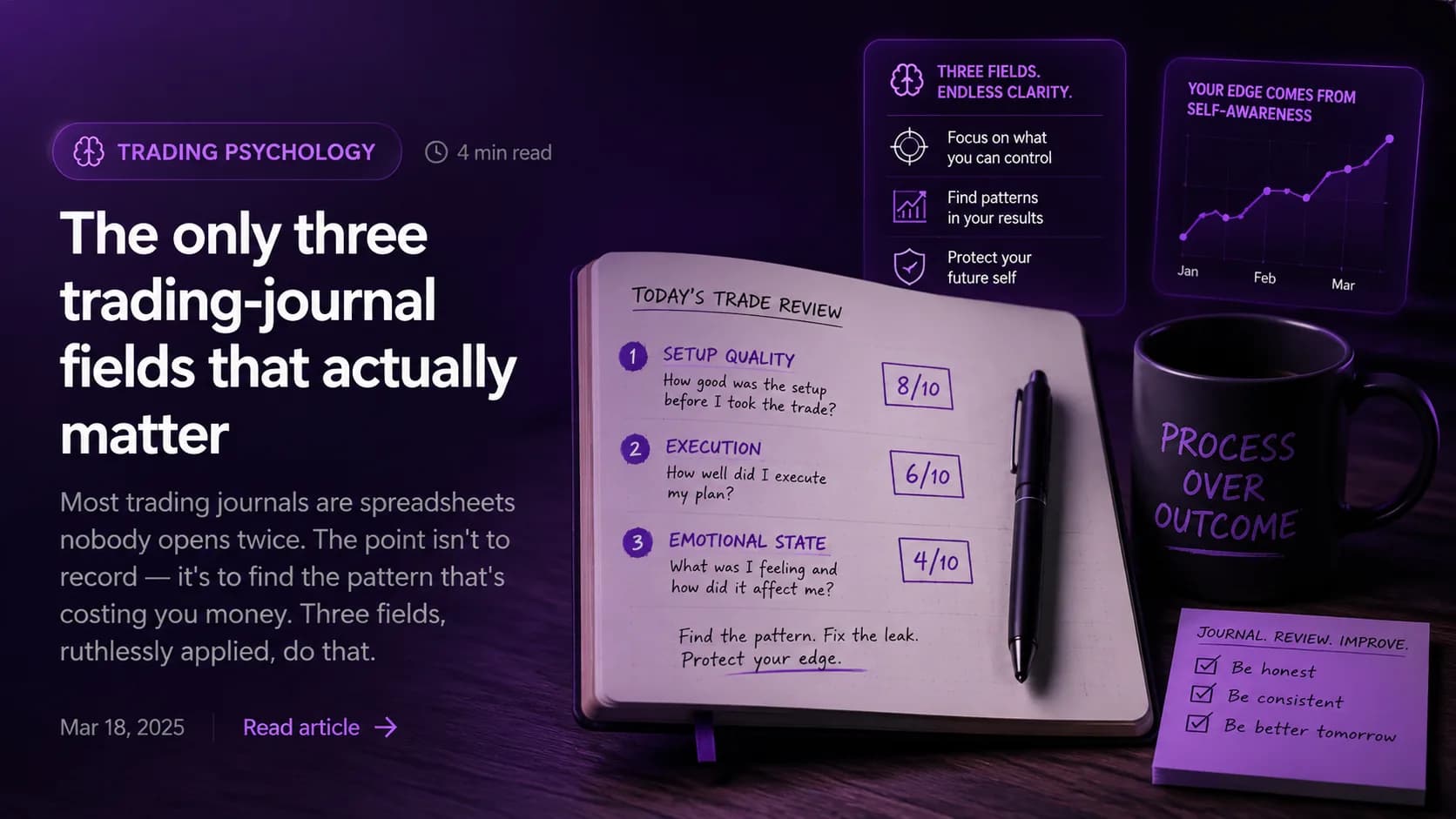
Most trading journals are spreadsheets nobody opens twice. The point isn't to record — it's to find the pattern that's costing you money. Three fields, ruthlessly applied, do that.
A trading journal exists for one reason: to make tomorrow's losing trades smaller than today's. Anything in the journal that doesn't serve that goal is decoration. Three fields, kept honestly, will do more for your P&L than every indicator combo you've ever tried.
Field 1 — Why I entered, in one sentence
Before clicking buy or sell, write the reason. "Bullish reversal off 1.0820 with hourly bullish divergence." That's a sentence. Not "setup looks good." If you can't fit the reason in one line, you don't have a reason — you have a feeling. Feeling-trades are the ones that hurt the most when they go wrong.
Field 2 — What would prove me wrong
Before entering: the price level, the time, or the event that would invalidate the thesis. "Wrong if 1.0790 breaks intraday" or "wrong if FOMC sounds dovish." This field forces you to define the exit before emotion can negotiate with you. If you can't write it, the trade is unrigorous.
Field 3 — Did the outcome match the thesis?
After the trade closes: did it close because the thesis worked, because something unrelated saved you, or because it stopped at noise? "Right thesis, right exit" is repeatable. "Right thesis, wrong exit" means you mismanaged. "Wrong thesis, right outcome" means you got lucky — repeating the same setup will hurt eventually.
Read the third field weekly. Patterns emerge fast: the same hour of day, the same instrument, the same emotional state. That pattern, once seen, is what changes.


